

One of the many hats I sometimes wear is as the representative for small consumers in the preferred portfolio working group, working on the Railbelt’s Integrated Resources Plan. What that mouthful actually means is a Zoom meeting of stakeholders and consultants talking through how to model the system. How should gas price volatility be modeled? What data is missing? How can we get to a point where everyone trusts the numbers when some are protected by confidentiality?
We want to get a good model, then run it on future scenarios and figure out plans for the grid as a whole. Committing to new projects just before we finish the plan ruins the whole concept. But we’ve done it before, and may be doing it again.
HEA already committed to build a new gas generator in February. GVEA narrowly voted to do the same thing in August, though they’re not committed yet. Last time we did this the Railbelt ended up with a billion dollars of gas plants, some of which don’t get used much.
We were in exactly the same place in 2010: A gas crisis precipitated a Railbelt-wide planning process. Meanwhile, utilities were building their own fossil-fuel infrastructure in a way that may have increased costs for consumers. According to the 2010 plan these plants were 5.6% more expensive than the alternative, CEA calculated that it cost $200-$500 million extra, and those plants have, as of 2025, made up less than half the capital cost in fuel savings.
HEA and GVEA are planning new gas turbines
Both HEA and GVEA are pursuing adding new gas turbines to existing plants (the same type of turbine -- it can burn gas or liquid fuel). HEA originally included the upgrade in a 2024 resolution that also approved a solar power contract. The solar contract later fell through when the developer pulled out, the project costs increased 54% to $77 million, and the HEA board took a final vote on the project in February. GVEA took its first vote on moving forward with its project in August, with placeholder project costs of $80 or $150 million. Neither decision was unanimous.
In both cases, the rationale presented at the public meetings was siloed to that specific utility. It’s kind of chicken-and-egg. Right now, there is no structure to standardize costs of moving power between utilities, no integrated plan, and power sales are limited by lack of fuel to generate the power. However, all of these things are likely to change by the time anything new can be built. The first two are both mandated and in progress, and presumably the fuel crisis does have to be solved one way or another before everything goes dark.
HEA justified their new turbine (some replacements were needed due to plant age, but that would have been much less expensive) based on saving fuel costs through plant efficiency. If you assume a gas price trajectory that ramps up to a little over $15 per Mcf in 2035 from about $10 today, and continue using the plant a lot, it pays back in 22 years. The urgency was based on the data center driven turbine crunch. Having entered a turbine queue in 2024, the utility had to commit or lose the spot and the price.
GVEA’s slide deck mashed together three different justifications. An immediate need for more generation capacity, fuel cost savings through plant efficiency, and an implied threat of mines and military customers leaving their system.
GVEA’s turbine-buying rationale makes no sense with the timing, and goes against the Railbelt integration they’ve been pushing for years
I’m focusing on GVEA not because they’re doing something fundamentally different than utilities always have, but because they haven’t committed to it yet, they’re starting this process at the exact same time their representative is sitting in meetings to build a Railbelt-wide plan, and because the detailed slide deck they provided makes it clear that there’s no good reason to do this right now.
Andrew McDonnell did an analysis of their arguments -- he’s a wind developer and involved with the RRC, but did this as an independent energy nerd. He shared it with the GVEA board, and with me, and gave me permission to post it here. It goes into more detail on some of the points I make below.
You can’t solve this year’s problem in 5 years
GVEA’s immediate problem is that its industrial customers (mines and the military) are increasing their use, and they may not have enough generation to always meet the peaks.
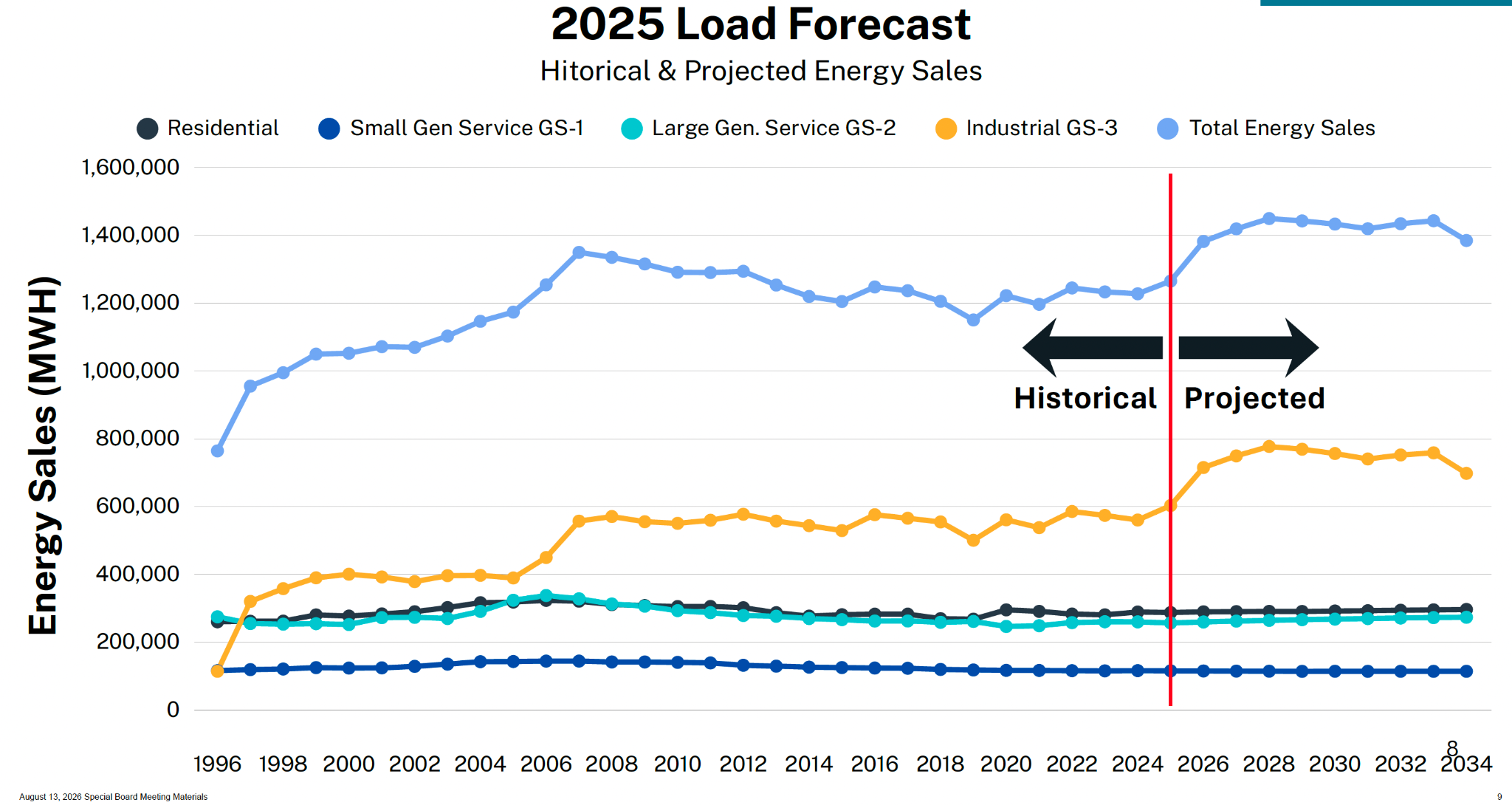
Their models show that if they do nothing, there may be 3-17 times per year where they don’t have enough power plants to meet the peak demand. But they also show the load jumping this year and then flattening out. So none of the solutions they discuss (new gas turbine, wind, batteries…) match the timing of the problem. Some of the only things that could solve it are getting power at peak times from other utilities, demand response programs, or planned cutoffs of industrial load.
Notably, their other customer loads aren’t growing. Huge swaths of the country are up in arms over data center plans at least in part because increased energy needs cause utilities to build new infrastructure, with other customers shouldering some of the costs and risk. Structurally, this is the same thing -- an industrial load doesn’t have to be a data center to raise the same issues. And with an existing load, you have to worry both about growth and shrinkage. Several of GVEA’s slides talk about how much rates would go up if the mines started generating their own power. It seems unlikely to me -- if it were easy to do that with greater reliability/lower cost GVEA would have done it already, but even a threat can matter. Historically, the refinery on the Kenai peninsula used the fact that they have their own generators to negotiate a rate lower than any other Railbelt customer (they paid $0.13/KWh all-in in 2025), even though they buy most of their power from HEA.
Andrew’s analysis looks at past installations of the same turbine in Alaska and finds they took 3.8-5.8 years. A used turbine could potentially come online that quickly, but a new turbine almost certainly couldn’t. The data center buildout is pushing out timelines and driving up prices. HEA’s previously-negotiated generator cost is less than half of what the consultants now estimate in the integrated resource plan.
The cost savings argument doesn’t look at a realistic set of future options.
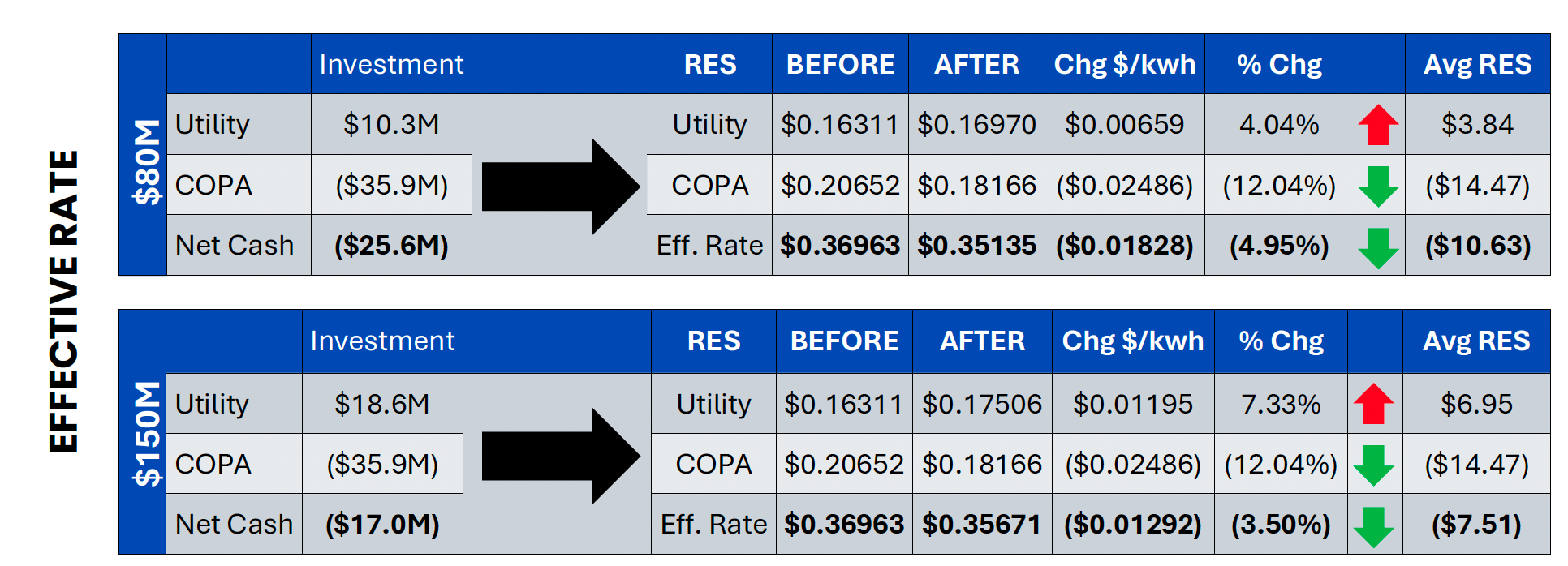
GVEAs slides show customer base rates going up -- due to paying for a new generator. And fuel costs going down -- as that generator burns less expensive fuel to produce the same amount of power. They use a snapshot of today’s COPA prices (the ones filed for next quarter are already lower than the “after” column), rather than a range of predicted prices.
And they similarly use a snapshot of today’s generation, assuming they get the same amount of power from the new generators as they currently get from their old ones.
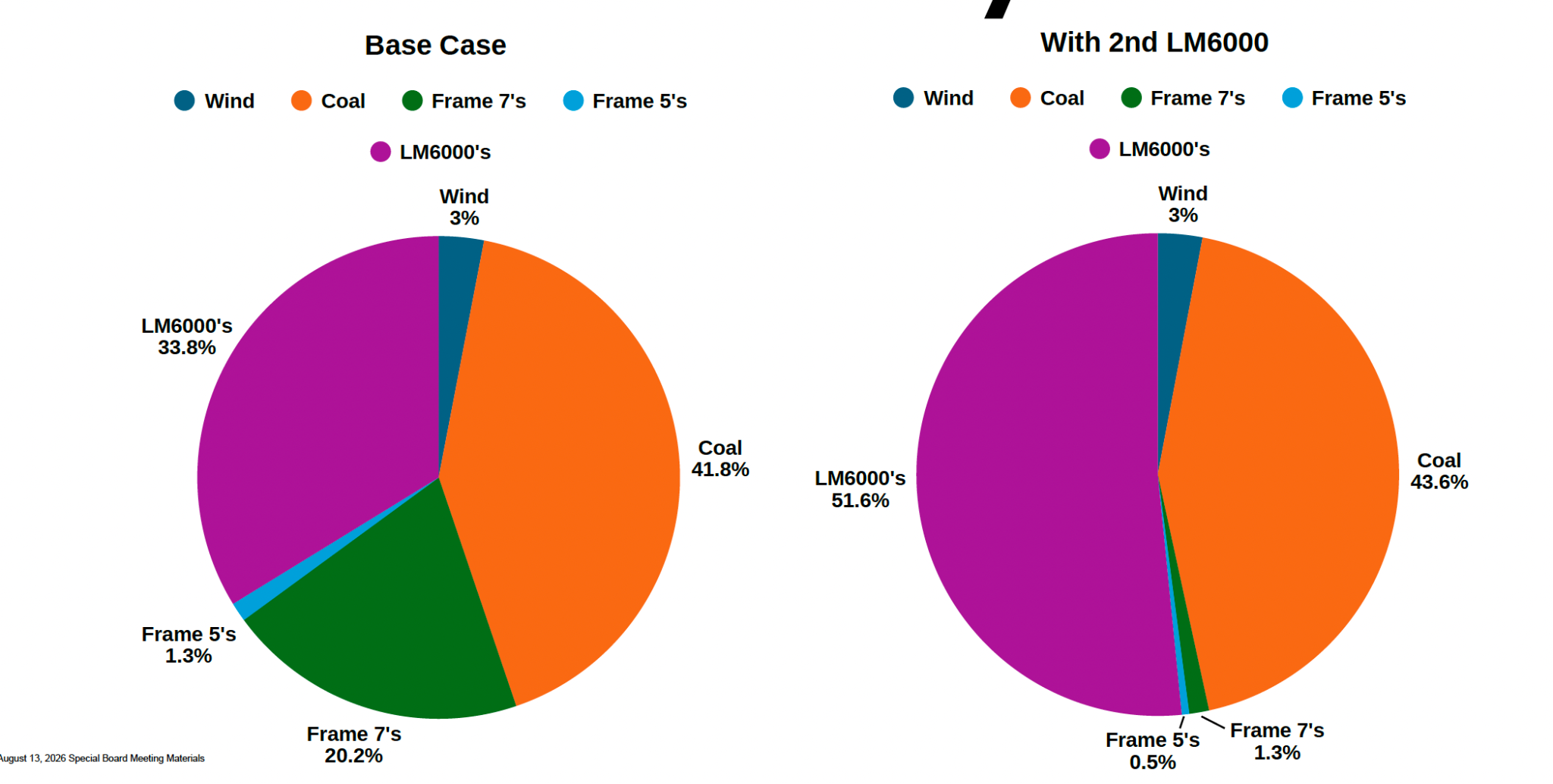
This isn’t so much a future prediction as a “what if we had this right now” scenario. Those pie charts don’t include GVEA’s own plans for Delta wind, the state’s plan for Dixon Diversion, any power coming from the south (not even Bradley Lake, which confuses me), or any other possibilities at all. Until very recently, GVEA got a large amount of gas power from Southcentral utilities. That isn’t possible now due to the gas supply shortage, but that will have to change by the time a new generator could be built.
An under-used generator is expensive on a per kilowatt hour basis. Andrew’s analysis says that if the new turbine was used at less than 10% of its capacity, it would cost 20 to 50 cents per Kwh just for the plant costs. We have examples of that principle on the Railbelt today.
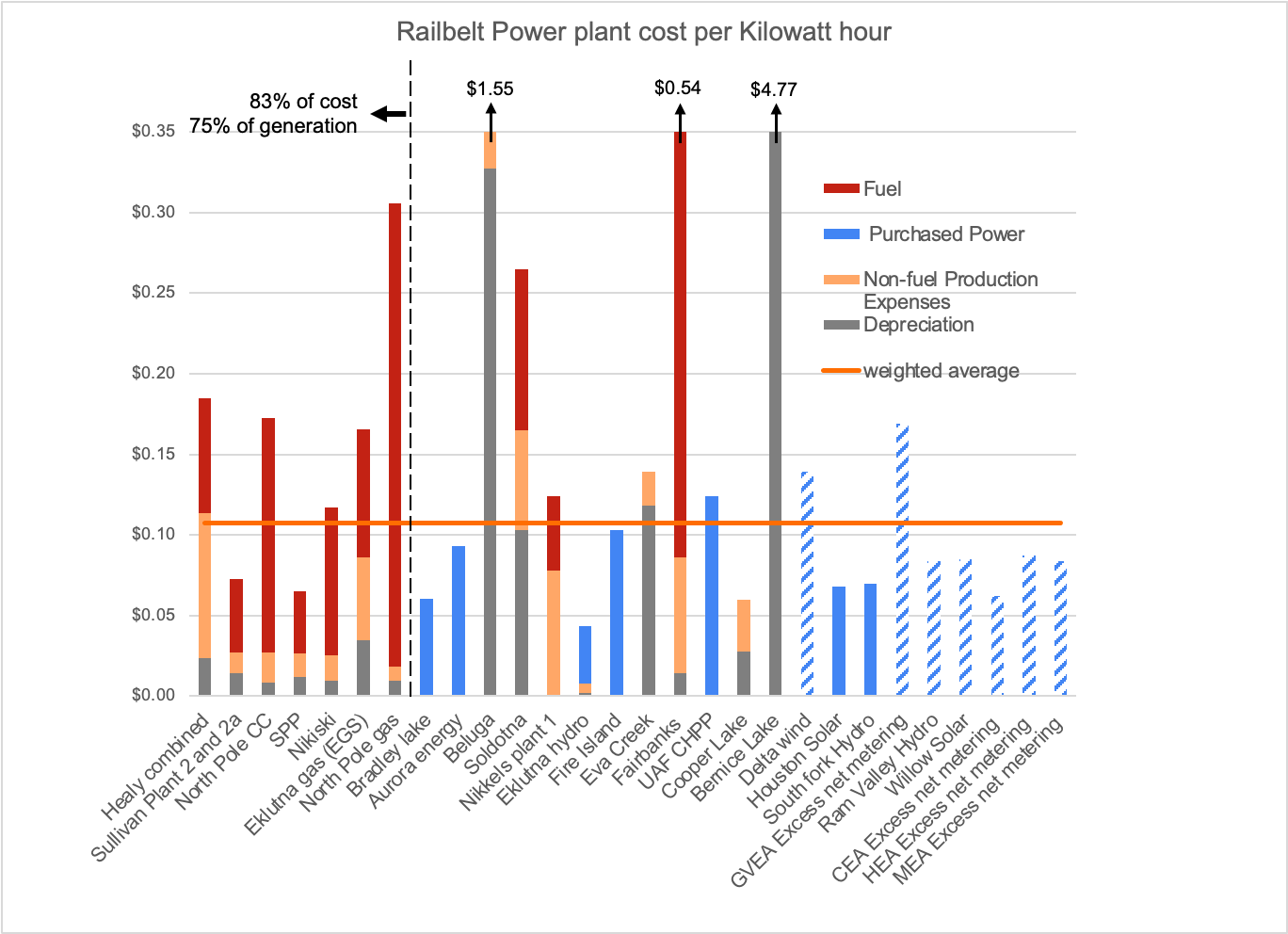
From my analysis of current plant costs.
EGS and Soldotna are both newer (post 2010) gas plants with relatively high per kilowatt hour costs driven less by inefficiency and more by spreading out their fixed costs over a low number of kilowatt hours. Last year EGS had a 21% capacity factor, and Soldotna’s was 5%.
Why not wait for the Railbelt-wide plan?
GVEA’s new turbine plan isn’t necessarily a bad idea. The set of assumptions they used could happen. And there’s always a tradeoff between planning and action. We’re still “planning” gas import facilities and may well keep doing that up to or after the point that we run out of gas. We spent a lot of time “planning” wind and solar projects, but while the US as a whole diversified its generation up to nearly 20% wind and solar, we more or less stopped over a decade ago, missing out on both tax credits and fuel savings.
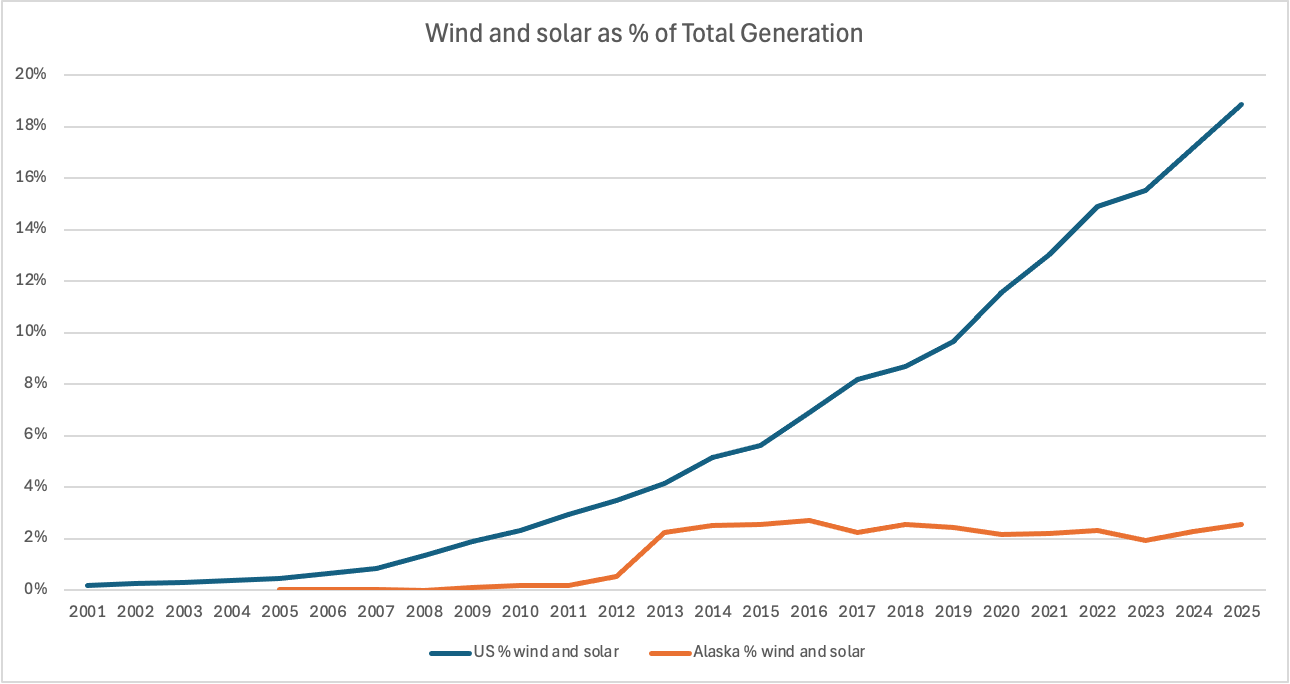
EIA data
But in this case GVEA voted to move this project forward in the midst of the Railbelt planning process, knowing that the RCA would need to provide special approval if their turbine doesn’t end up in the final selection. (I’m not sure if this applies to HEA’s project or not -- the rules of grandfathering are a little confusing). Only a week after the vote, GVEA’s rep to the planning meeting said that he’d be happy for the model to evaluate their turbine. He expects it will show that it’s a good idea, but seemed open to finding out otherwise. That seems like a better attitude.
What about non-utility projects?
There are also projects being pursued by the Alaska Energy Authority, notably the power line across Cook Inlet and the expansion of Bradley Lake hydro through the Dixon Diversion project. These don’t face the same RCA approval hurdles, since the RCA has no authority over the state. And they were designed with the whole Railbelt in mind.
Still, there was almost-universal agreement in the planning meeting not to just assume they’re going to happen. Alaska is littered with big projects with sunk costs, grants awarded, and lots of effort put in that nonetheless do not actually end up getting built.
But the most important assumptions for our Railbelt plan might be the ones that are even more uncertain and less under the plan’s control. Where will fuel come from, and what will it cost?