

Last year, I wrote about how annual net metering could provide a significant incentive for people to install solar panels while having basically no impact on the economics of utilities’ other members. Since then, the initial net metering bill introduced by Dunleavy has taken two divergent paths. The current version of SB 150 likely wouldn’t actually accomplish any of the incentive, and instead provides a sneaky way to dismantle the current monthly net metering system, leaving us worse off than today. The current version of HB 164 is actually an improvement over last year’s version, adding a few numerical guardrails to assuage people’s unreasonable fears.
This is the third time I’ve written about net metering (read 1 and 2 here), and as a numbers person, I find it frustrating because the debate seems to endlessly circle the same place. In short: “We can’t allow people to get full credit for their solar energy! Look at how they decided to stop that in Hawaii!” vs. “We are not Hawaii!” Read on for the weeds and the math, but yeah, we really aren’t Hawaii, and no one in Alaska needs to worry about their neighbor installing solar panels.
A quick primer: Net metering is the system where a home or business gets charged for the “net” amount of electricity they consume -- the amount they take in from the grid minus the amount they export to the grid. On the Railbelt, this true-up happens every month. In the summer months, this means some people produce more than they use. This extra production gets reimbursed at a lower wholesale rate. Annual net metering basically makes the true-up happen annually, so extra production in the summer can offset use in the winter.
With the loss of federal tax credits, solar panels don’t pay off economically as well as they did before -- annual net metering would help keep them more attractive. On average, annual net metering would put the payoff for folks installing solar panels roughly back to where it was with tax credits and monthly net metering.
In addition to being a big deal for the folks that have them, these solar panels provide a small but real benefit to the system as a whole, reducing the amount of oil and gas burned for power. While utility-scale systems could theoretically have a much bigger benefit, the reality is these home solar systems are one of the few bright spots on a grid that otherwise isn’t doing much of anything at all. Most of the renewable energy added to the Railbelt in the last 5 years is from these distributed solar systems, and they produce around twice as much energy as our utility-scale solar projects (utility-scale solar produced around 8 million kilowatt hours in 2025, while small scale solar produced over 17 million kilowatt hours).
The debates about net metering generally aren’t talking about that. Instead, they’re talking about how to stop net metering from raising other people’s rates.
Why? The basic structure of electric rates means that all else being equal, people using less electricity will make rates go up. I’ve written extensively about this before -- it doesn’t mean that people with solar panels are always paying less than their fair share, that conservation is a subsidy, or that a state should start paying utilities for lost revenue any time it funds a weatherization program or insulates some school buildings.
But those are philosophical arguments that do not matter in Alaska right now, and possibly not for the next hundred years.
We are not Hawaii
You can tell a story about how other states had net metering, which reduced electricity sales so much that they passed new laws to change the rules. It’s a true story -- both California and Hawaii did this. But the key plot point is when they changed those rules -- when small-scale solar was generating around 5 or 6 percent of total energy on the system. Whatever you believe about fairness, that’s enough energy to change the math.
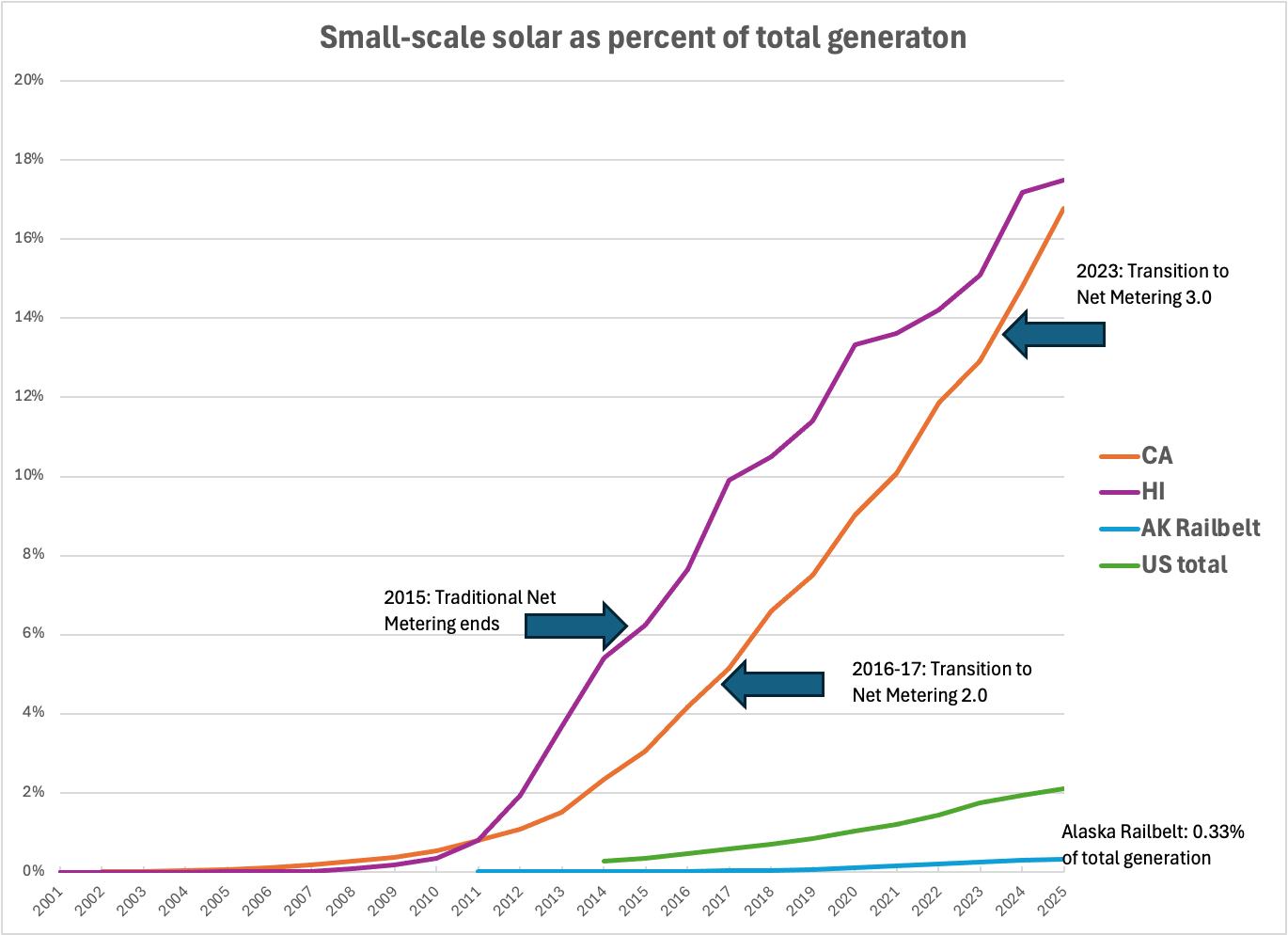
The lesson here isn’t “net metering is a bad idea” -- it’s “net metering is a good incentive system for low levels of solar penetration.” Like Alaska levels.
On the Railbelt, we get around a third of one percent of our energy from small-scale solar, far less than the 2% national average, and not even in the same universe as California and Hawaii. At the current rate of installation (around 2.5 megawatts of new solar each year), we’ll reach the 5 or 6% level where those other states adjusted their laws in a little over 100 years.
Maybe installation rates will increase enough that that century turns into decades. I hope they do. But that isn’t a problem for the current legislature.
SB 150 holds distributed solar hostage to legislative funding, while HB 164 ties guardrails to actual impacts.
In my original post on annual net metering, I discussed the “I’m scared of solar panels” fund, where the legislature can appropriate money to pay utilities for revenue losses due to net metering (though it’s still unclear whether that applies only to power fed into the grid by those panels, or to an estimate of how much power those people would have bought if they didn’t have panels).
Both bills keep the fund, but take it in very different directions. Every Alaskan knows that the legislature is constantly struggling to fund the most basic functions of government. Which means that despite Alaska Energy Authority having some seed money for it, the fund is probably going to be pretty low on the legislative priority list when that’s gone.
SB 150 uses an empty fund as an excuse to cut off net metering entirely for anyone who doesn’t already have solar panels -- not just annual net metering, but also the current monthly version.
(f) A load-entity is not required to provide a net metering service under this section unless the commission determines that the net metering reimbursement fund established under AS 42.45.015 is sufficiently capitalized to adequately offset revenue lost in excess of avoided costs because of the net metering service.
HB 164 allows annual metering to keep going without the fund, instead adding a guardrail that it can’t raise rates for nonparticipants by more than 2%
(e) If funds are not available in the net metering reimbursement fund established under AS 42.45.015 and revenue losses attributable to a load-serving entity’s net metering service would require the entity to request approval from the commission to increase rates for customers who are not consumer-generators by more than two percent annually, the entity may request approval of the commission to modify rates for consumer-generators. A rate modification under this subsection may not increase rates for consumer-generators more than is necessary to avoid increasing rates by more than two percent annually for customers who are not consumer-generators.
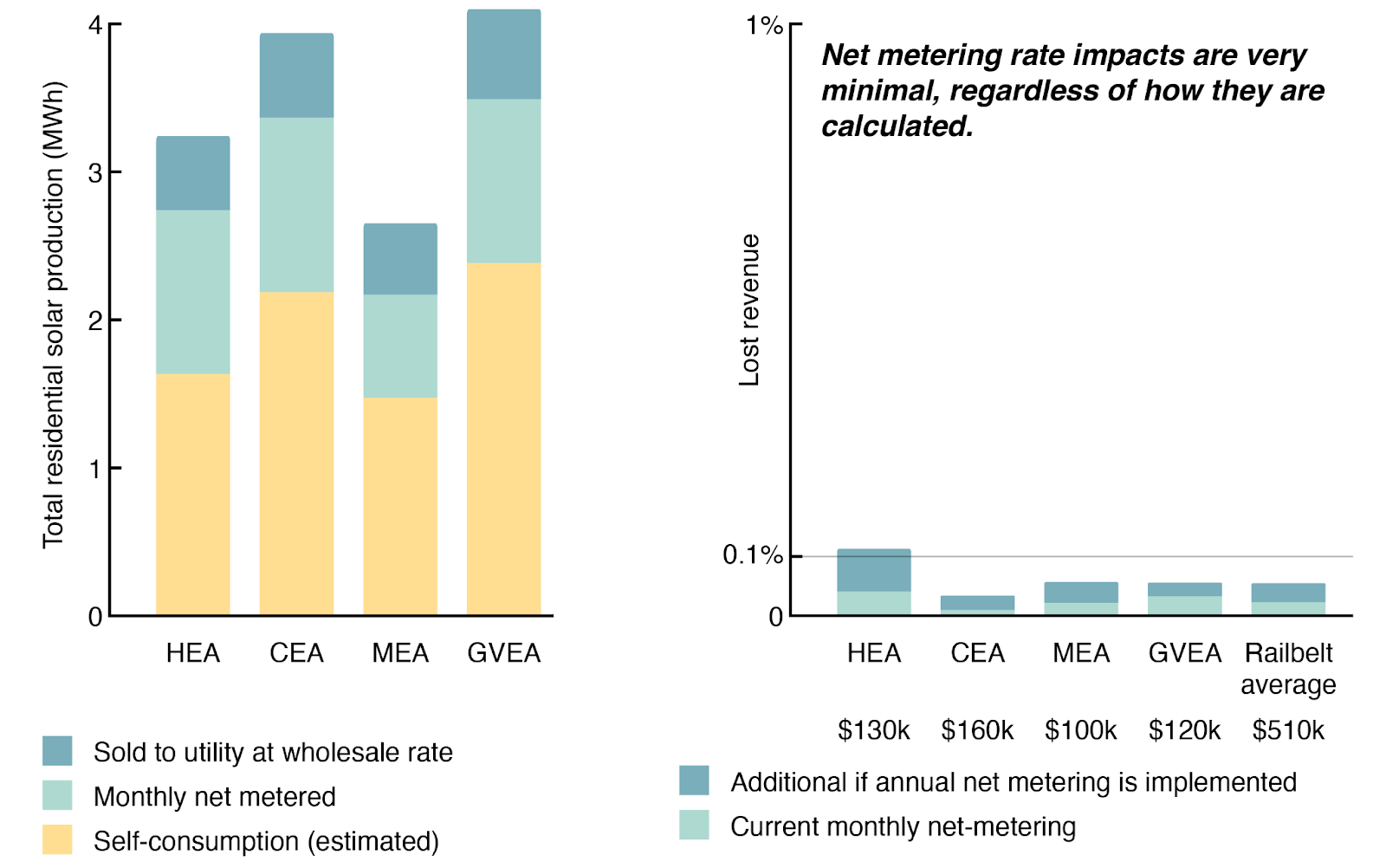
This is a reasonable guardrail. A 2% rate increase would be around half a cent per kilowatt hour on the Railbelt today -- not huge, but not nothing either. Right now, a switch to annual net metering would leave rate impacts at or below 0.1% -- completely irrelevant to other consumers, and more than 20 times below the level set by that clause.
Even worse, SB 150 allows utilities to dismantle the current monthly net metering system
(e) A load-serving entity may establish an innovative residential rate structure, under regulations adopted by the commission, that accurately reflects the entity’s costs to provide electrical service to consumer-generators that receive net metering service.
There’s a lot hiding here in the word “innovative” -- under this bill, utilities could charge high fees to solar panel owners, change the reimbursement rates to drastically drop the credit rates for solar power, set high minimum monthly purchase levels, or more. And the “accurate reflection” of costs isn’t any protection. There is no way to accurately determine the costs to provide service to any customer or group of customers. Instead, the “cost-causer, cost-payer” principle is shorthand for a particular crude way of lumping costs into buckets that’s been used for decades to set electric rates.
This sort of change is how Hawaii and California dismantled their original net metering programs -- once they’d reached levels vastly higher than Alaska has today.
In general, the costs of providing electrical service to someone with solar panels are the same as providing it to any person who bought the same amount of energy. A big house with solar panels and a heat pump pays more in the ‘fixed costs’ utilities like to talk about than a small cabin with no solar panels (my old post has actual examples of this)
HB 164 cuts off new installations in 2037
In addition to the 2% rate increase protection, HB 164 sets a sunset date of 2037 for new installations. I don’t think this is necessary, and the rate protection is a much more elegant way of addressing the hypothetical problem -- who knows how much solar will really get installed in the next decade?
Even if we dramatically increase the installation rate, we’re starting at such a low level that ten years won’t get us anywhere close to 2015 Hawaii. Even installing five times as much solar every year for a decade will leave us below the 2% rate increase threshold. Almost certainly the sunset will kick in first.
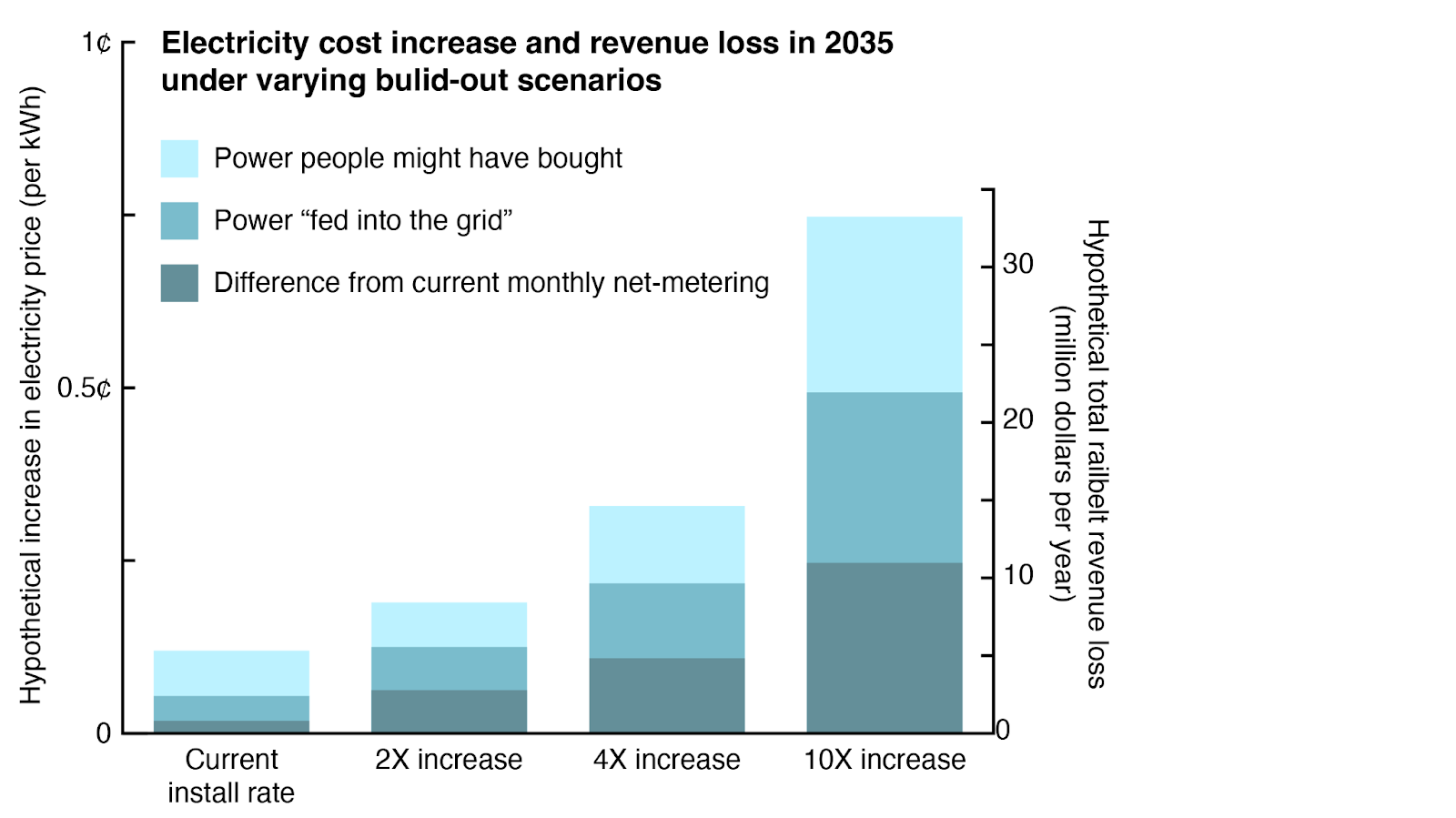
In the ‘current installation rate’ scenario I assumed that the percentage of net metering and overproduction equals that of today. In the increased installation scenarios, I assumed only 1/3 of power was self-consumed, with 1/3 each over produced or consumed within the month, to account for larger installations being incentivized.
That said, a decade of annual net metering with a guardrail to keep people comfortable with the risks is a pretty good outcome.
In Conclusion -- the legislature should pass HB 164
This is a way easier conclusion than most. There are two bills, one is helpful, and one is worse than status quo. We should pass the better one!
I really hope that we’ll start seeing some meaningful increases in utility-scale renewable generation on the Railbelt. In the meantime, we should help homeowners and businesses keep chipping away at the problem, a few kilowatts at a time.